Showing posts with label technology. Show all posts
Showing posts with label technology. Show all posts
Saturday, December 3, 2016


Friday, January 24, 2014
Happy Birthday to Apple (Macintosh)
Over the years, the popular computer has been molded into many shapes and sizes, constantly in redesign mode. Championed by the revolutionary Steve Jobs, Mac computers have risen to the top of the food chain, one of Apple’s many landmark achievements. These days, most Mac computers are sleek and slender, sporting a crisp display and a variety of different size options.
Let`s see the remarkable evolution of the personal computer.
 1. Lisa – In 1983, Apple debuted its first model, the Apple Lisa. The computer took more than three years to make, and around $50 million to develop. Named after Steve Jobs’ daughter, the computer was quite pricey, clicking in at nearly $10,000 (about $25,000 by today’s standards). The high price tag repelled most consumers, and the computer sold poorly.
Though not technically a Mac, the Lisa nonetheless influenced the first Macintosh, which Jobs debuted on Jan. 24, 1984.
 2. Macintosh XL – In order to ramp up Lisa sales, Apple redesigned the model in 1985, renamed it the Macintosh XL and lowered the price to $3,495.
 3. Macintosh 128K - Introduced in 1984, the 128 model was the first true Macintosh personal computer, and retailed for about $2,495. With its 9-inch screen, 128K of RAM and “easy to use” accessibility, the Mac was off to a robust start.
 4. Macintosh 512K - Released right after the 128, the 512 was virtually the same, but had four times more memory.
 5. Macintosh Plus - Enter 1986, when the Macintosh Plus emerges into the market. It had 1MB of RAM and cost about $2,599. It also came with an SCSI port, which meant users could install external hard drives.
 6. Macintosh Portable - The first battery-powered Mac creation entered the arena in 1989. It was considered fast for its time, operating at 16 MHz. Though it was quick, the Portable sold poorly and weighed nearly 16 pounds.
 7. Powerbook – The Powerbook came out a few years later, in 1991, and was Apple’s first true portable computer, thanks to its lightness. The floppy disk drive was a separate, external entity. The line had staying power, continuing until 2006.
 8. iMac – The iMac debuted in 1998 and was one of Apple’s first big projects after anointing Steve Jobs its CEO. Translucent and brightly colored, the iMac was a stylish step above its predecessors, and did away with floppy disk drives, opting instead for USB ports.
 9. iMac G4 - The iMac G4 marveled tech lovers with its flexibility and flattened shape. Because of its thin neck, the screen could be pulled forward and swiveled around. The 2002 creation literally had audiences gasping during Steve Jobs’ keynote.
 10. MacBook - Apple trotted out the new MacBook in 2006, noted for its built in “iSight” webcam, crisp and glossy LCD screen and integrated keyboard.
 11. MacBook Air - The holy grail of modern day MacBooks, the Air is Apple’s sleekest invention, touted as the world’s thinnest notebook (due in part to the removal of the CD/DVD drive). Jobs unveiled it in 2008, and the line has continued to pump out redesigned and updated models. The original had an 80GB hard drive and bright LED backlighting.
 12. iMac today - Thinner and larger than past models, the modern iMac features a slender screen and a detached keyboard and mouse. The most recent 27-inch version sports a lighting-fast Intel processor and Fusion Drive data storage, which combines a traditional hard drive with Flash storage.
Source: http://mashable.com/
Thursday, November 17, 2011
One Man s War Against Facebook on the European Front
Max Scherms is a 24-year-old law student from Vienna who is hell-bent on
changing the rules Facebook plays by. As a visiting student in
California last semester, he was puzzled by a class visit from a
Facebook representative, whose ideas of European privacy laws were very
different than Scherms's own understanding. Since then, he's filed 22
complaints against Facebook Ireland Limited, the subsidiary that
oversees European users of the social network, for everything from
poking to tagging to facial recognition. He's also started a group
called Europe Versus Facebook, which fights for users to obtain more
power over their own information. For example, did you know that the
Facebook "Like" button gathers user information, not just every time you
click it, but every time you end up on a page that contains the button
at all? That cookie then associates the page with all the others you've
visited over the last three months.
"The first problem is the lack of transparency," Scherms told us via
e-mail today. "The second problem is the lack of user control. We
deposit our data at Facebook, but we cannot to efficiently control what
is happening to them." Even if you're deleting things from your profile,
they're still keeping the information, he contends, and so you're
"actually just hiding it from yourself."
Although his movement is based in Europe, Scherms says that if he's
successful, Facebook will be forced to implement changes worldwide, "so
it is very likely that U.S. residents will get more rights too." Scherms
also has an eye on Google+, although he has no legal rights to file
complaints against them in Europe.
Like most twentysomethings, though, Scherms is also insistent that he's
a fan of the services provided. "I think that social networking is a
pretty cool thing, so I don't see why I should limit myself just because
Facebook is not following the laws," he said. Plus, he added, "Facebook
has a monopoly on our friends."
Sunday, November 13, 2011
Buy any linux CD / DVD
If you want to buy any CD/DVD for Open Source,
go and buy it from the following link
http://linuxplate.in/ref/chiragkgohel
go and buy it from the following link
http://linuxplate.in/ref/chiragkgohel
Saturday, November 12, 2011
Tech that will Replace Credit Cards
Tech that will Replace Credit Cards
NFC,or near-field communication,is a variant of RFID,or radio frequency identification.It is an ultra short-range wireless technology that allows communication and data exchange between two devices held in tight proximity - about 4 cm apart.
WHAT IS NFC
NFC,or near-field communication,is a variant of RFID,or radio frequency identification.It is an ultra shortrange wireless technology that allows communication and data exchange between two devices held in tight proximity - about 4 cm apart.
HOW IS IT DIFFERENT FROM BLUETOOTH
Bluetooth is also a short-range high frequency wireless technology but one that allows interaction between communication devices as much as 10 meters apart.
WHAT MAKES NFC SPECIAL
NFC-enabled smartphones have the potential to replace credit cards.This is because NFC phones pack a smart chip - a complex 80-character code that is really hard to crack.Such a device can safely store confidential credit card details and be handy for purchases on the go.Frost & Sullivan predicts the technology will revolutionise e-commerce and drive over $150 billion worth of transactions by 2015,bulk of which is expected to be powered by NFC phones.
WHAT ELSE CAN THE TECHNOLOGY DO
NFC can be deployed in ticketing services,rural banking,interactive and targeted advertising,healthcare,
HOW DO NFC TRANSACTIONS WORK
Any device,a cellphone,a camera or a watch,can be equipped with an NFC initiator',which is simply an antenna that can store data.If the device is an NFC smartphone,the 'initiator' and 'target' (an NFC reader) need to be up close for data exchange to happen.The `reader' is attached to a point-of-sale (PoS) terminal or cash-register in a retail store that accepts NFC payments.A simple wave of the phone can pay for a purchase.Alternatively,two NFC phones can be tapped lightly to exchange business cards.
WILL NFC BE A DRAIN ON BATTERY LIFE
Geeks claim that in standby mode,a well-designed NFC solution does not consume any power.And since transactions happen in seconds,the power drain is not huge.
ARE NFC-ADOPTION LEVELS GROWING
Globally,NFC adoption is picking up via smartphones.RIM,Nokia,Samsung and HTC have unveiled NFC smartphones.Apple iPhone5 is tipped to support NFC too.Google Wallet -- a mobile payments technology that can be downloaded on some US mobile networks -- is growing the NFC ecosystem.Payment trials have also begun in Australia,Singapore and China.
HAS NFC ARRIVED IN INDIA
The technology is still in its infancy here.As of now,the Reserve Bank does not recognise NFC mobile payment transactions and PoS terminals accepting NFC payments don't exist.But NFC-enabled phones like BlackBerry's Touch Bold 9900 and Curve 9360,Samsung's Nexus S and Galaxy S II and Nokia's C7,700,701 and 600 are available.For NFC to take off,RBI has to frame norms and banks,carriers,creditcard companies,apps developers and PoS terminal makers have to team up.But awareness levels are growing and NFC is making some waves in entertainment.ShahRukh Khanstarrer Ra.One was the first movie to be marketed by Nokia using NFC technology.Armed with an NFC phone,you can download the movie content by merely tapping the device on a NFC-tagged movie poster at a Nokia priority outlet or a partner multiplex.
NFC,or near-field communication,is a variant of RFID,or radio frequency identification.It is an ultra short-range wireless technology that allows communication and data exchange between two devices held in tight proximity - about 4 cm apart.
WHAT IS NFC
NFC,or near-field communication,is a variant of RFID,or radio frequency identification.It is an ultra shortrange wireless technology that allows communication and data exchange between two devices held in tight proximity - about 4 cm apart.
HOW IS IT DIFFERENT FROM BLUETOOTH
Bluetooth is also a short-range high frequency wireless technology but one that allows interaction between communication devices as much as 10 meters apart.
WHAT MAKES NFC SPECIAL
NFC-enabled smartphones have the potential to replace credit cards.This is because NFC phones pack a smart chip - a complex 80-character code that is really hard to crack.Such a device can safely store confidential credit card details and be handy for purchases on the go.Frost & Sullivan predicts the technology will revolutionise e-commerce and drive over $150 billion worth of transactions by 2015,bulk of which is expected to be powered by NFC phones.
WHAT ELSE CAN THE TECHNOLOGY DO
NFC can be deployed in ticketing services,rural banking,interactive and targeted advertising,healthcare,
HOW DO NFC TRANSACTIONS WORK
Any device,a cellphone,a camera or a watch,can be equipped with an NFC initiator',which is simply an antenna that can store data.If the device is an NFC smartphone,the 'initiator' and 'target' (an NFC reader) need to be up close for data exchange to happen.The `reader' is attached to a point-of-sale (PoS) terminal or cash-register in a retail store that accepts NFC payments.A simple wave of the phone can pay for a purchase.Alternatively,two NFC phones can be tapped lightly to exchange business cards.
WILL NFC BE A DRAIN ON BATTERY LIFE
Geeks claim that in standby mode,a well-designed NFC solution does not consume any power.And since transactions happen in seconds,the power drain is not huge.
ARE NFC-ADOPTION LEVELS GROWING
Globally,NFC adoption is picking up via smartphones.RIM,Nokia,Samsung and HTC have unveiled NFC smartphones.Apple iPhone5 is tipped to support NFC too.Google Wallet -- a mobile payments technology that can be downloaded on some US mobile networks -- is growing the NFC ecosystem.Payment trials have also begun in Australia,Singapore and China.
HAS NFC ARRIVED IN INDIA
The technology is still in its infancy here.As of now,the Reserve Bank does not recognise NFC mobile payment transactions and PoS terminals accepting NFC payments don't exist.But NFC-enabled phones like BlackBerry's Touch Bold 9900 and Curve 9360,Samsung's Nexus S and Galaxy S II and Nokia's C7,700,701 and 600 are available.For NFC to take off,RBI has to frame norms and banks,carriers,creditcard companies,apps developers and PoS terminal makers have to team up.But awareness levels are growing and NFC is making some waves in entertainment.ShahRukh Khanstarrer Ra.One was the first movie to be marketed by Nokia using NFC technology.Armed with an NFC phone,you can download the movie content by merely tapping the device on a NFC-tagged movie poster at a Nokia priority outlet or a partner multiplex.
Monday, November 7, 2011
ISRO builds India''s fastest supercomputer SAGA-220
ISRO builds India''s fastest supercomputer SAGA-220
Indian Space Research Organisation has built a supercomputer, which is to be India’s fastest in terms of theoretical peak performance of 220 TeraFLOPS (220 Trillion Floating Point Operations per second).
The supercomputer “SAGA-220″, built by the Satish Dhawan Supercomputing Facility located at Vikram Sarabhai Space Centre (VSSC), Thiruvananthapuram at a cost of about Rs 14 crore was inaugurated by K Radhakrishnan, Chairman ISRO at VSSC today, ISRO said in a statement.
The new Graphic Processing Unit (GPU) based supercomputer, “SAGA-220″ (Supercomputer for Aerospace with GPU Architecture-220 TeraFLOPS) is being used by space scientists for solving complex aerospace problems.
“SAGA-220” is fully designed and built by Vikram Sarabhai Space Centre using commercially available hardware, open source software components and in house developments.
The system uses 400 NVIDIA Tesla 2070 GPUs and 400 Intel Quad Core Xeon CPUs supplied by WIPRO with a high speed interconnect.
With each GPU and CPU providing a performance of 500 GigaFLOPS and 50 GigaFLOPS respectively, the theoretical peak performance of the system amounts to 220 TeraFLOPS, the statement said.
The present GPU system offers significant advantage over the conventional CPU based system in terms of cost, power and space requirements, it said.
The system is environmentally green and consumes a power of only 150 KW. This system can also be easily scaled to many PetaFLOPS (1000 TeraFLOPS).
Indian Space Research Organisation has built a supercomputer, which is to be India’s fastest in terms of theoretical peak performance of 220 TeraFLOPS (220 Trillion Floating Point Operations per second).
The supercomputer “SAGA-220″, built by the Satish Dhawan Supercomputing Facility located at Vikram Sarabhai Space Centre (VSSC), Thiruvananthapuram at a cost of about Rs 14 crore was inaugurated by K Radhakrishnan, Chairman ISRO at VSSC today, ISRO said in a statement.
The new Graphic Processing Unit (GPU) based supercomputer, “SAGA-220″ (Supercomputer for Aerospace with GPU Architecture-220 TeraFLOPS) is being used by space scientists for solving complex aerospace problems.
“SAGA-220” is fully designed and built by Vikram Sarabhai Space Centre using commercially available hardware, open source software components and in house developments.
The system uses 400 NVIDIA Tesla 2070 GPUs and 400 Intel Quad Core Xeon CPUs supplied by WIPRO with a high speed interconnect.
With each GPU and CPU providing a performance of 500 GigaFLOPS and 50 GigaFLOPS respectively, the theoretical peak performance of the system amounts to 220 TeraFLOPS, the statement said.
The present GPU system offers significant advantage over the conventional CPU based system in terms of cost, power and space requirements, it said.
The system is environmentally green and consumes a power of only 150 KW. This system can also be easily scaled to many PetaFLOPS (1000 TeraFLOPS).
Saturday, September 3, 2011
The Highest Railways in the World

Photo (Foto: China Photos/Getty Images)
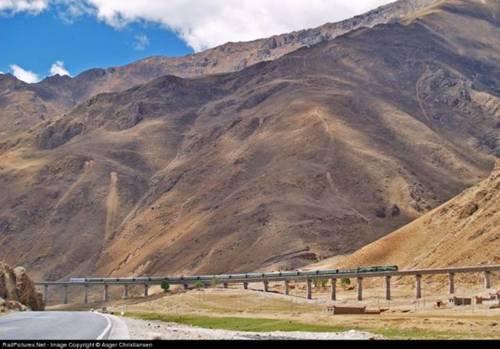
The Qingzang railway, Qinghai–Xizang railway, or Qinghai–Tibet railway is a high-altitude railway that connects Xining, Qinghai Province, to Lhasa, Tibet Autonomous Region, in China. The total length of Qingzang railway is 1956 km. Construction of the 815 km section between Xining and Golmud was completed by 1984. The 1142 km section between Golmud and Lhasa was inaugurated on 1 July 2006 by president Hu Jintao: the first two passenger trains were "Qing 1" (Q1) from Golmud to Lhasa, and "Zang 2" (J2) from Lhasa.This railway is the first to connect China proper with the Tibet Autonomous Region, which, due to its altitude and terrain, is the last province-level entity in mainland China to have a conventional railway. Testing of the line and equipment started on 1 May 2006. Passenger trains run from Beijing, Chengdu, Chongqing, Guangzhou, Shanghai, Xining and Lanzhou. 54 images after a break.......
The line includes the Tanggula Pass, which, at 5,072 m (16,640 feet) above sea level, is the world's highest rail track. The 1,338 m Fenghuoshan tunnel is the highest rail tunnel in the world at 4,905 m above sea level. It is known as the nearest door to the heaven. The 4,010-m Guanjiao tunnel is the longest tunnel from Xining to Golmod and the 3,345-m Yangbajing tunnel is the longest tunnel from Golmod to Lhasa. More than 960 km, or over 80% of the Golmud-Lhasa section, is at an altitude of more than 4,000 m. There are 675 bridges, totalling 159.88 km, and about 550 km of the railway is laid on permafrost. Text Via Link


v


v
v



Subscribe to:
Posts (Atom)